
 CYC Photon Gen2
 CYC X1 Pro Gen4
 CYC X1 Stealth Gen3
 Bafang BBSHD
 E-Bike motors BESTSELLER


Are you dreaming of an e-bike, but your current bike suits you perfectly? No problem. With our e-bike retrofit kits, you can transform your beloved bike into a comfortable e-bike. In this blog, you can find out everything you need to know about e-bike components. What is essential and what are optional extras? How does the system actually work?
Required components of the e-bike system:
- Motor and controller
- Chainring and cranks
- Speed sensor
- Main wiring harness
- Display
- Battery and charger
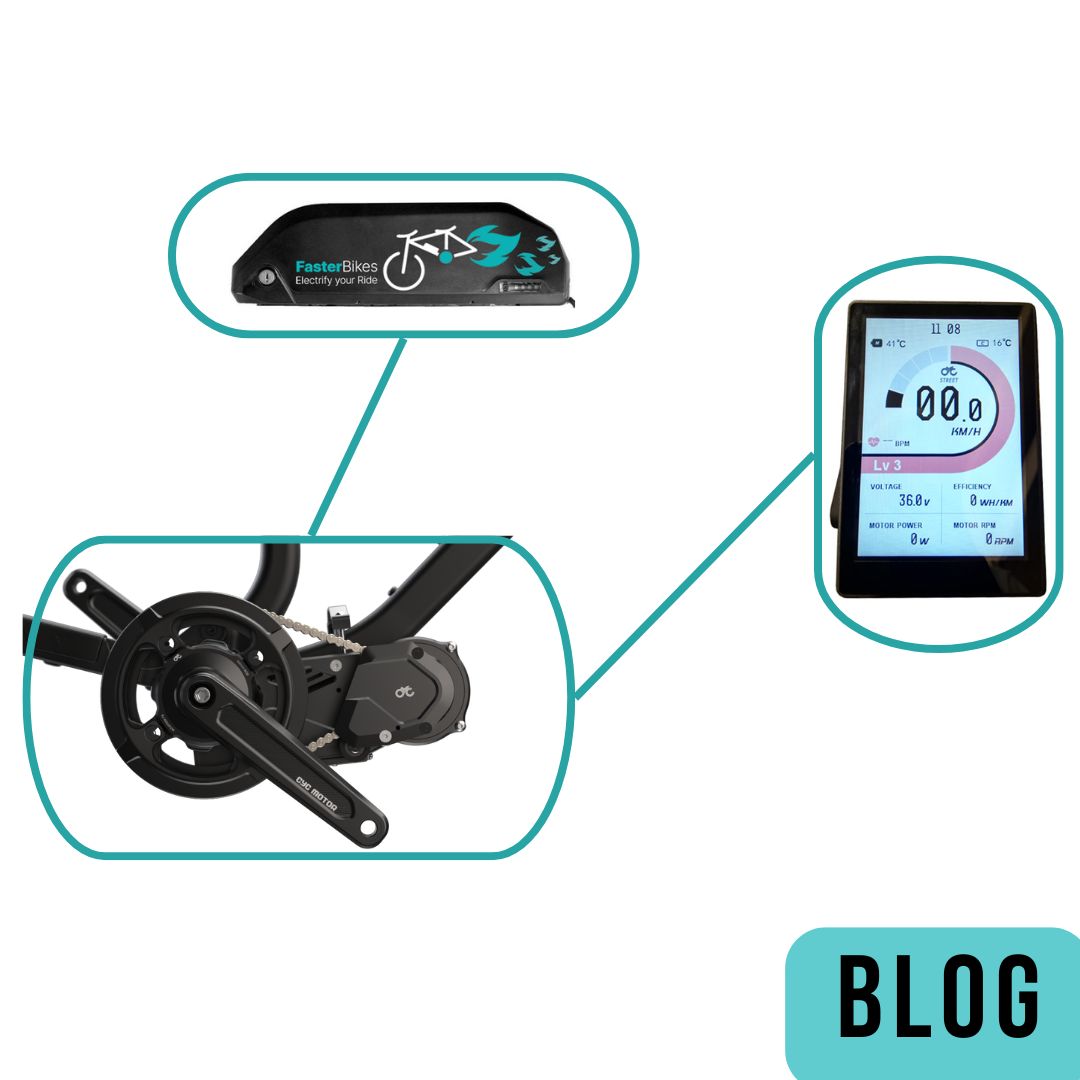
On e-bikes with a mid-motor, the motor is located at the bottom bracket (in the wheel hub for hub motors). The controller is the part of the mid-motor where the cables come out. It is the “brain” of the e-bike system and controls all processes. Many believe that the display takes over this task. However, this is incorrect, as the display is only a device for showing the parameters and is needed to switch on the system and select the support levels.
There are several cables on the controller to which the following components are connected:
- Main wiring harness: This leads from the engine to the front of the handlebars. This is where the display and optional throttle, shift and/or brake sensors are connected. The main wiring harness is already included when the motor is selected.
- Speed sensor: This sensor is usually mounted on the chainstay (frame) and the magnet on the spokes. This sensor detects the rotation of the tire, which the controller uses to calculate the current speed. This sensor is already included when the motor is selected.
- Battery: Most e-bike systems are compatible with 36V, 48V or 52V batteries (nominal voltage). There are different versions – from the bottle cage battery (practical, can be removed from the rail with a key) to the backpack battery (can also be stowed in a bag) to the custom-made battery (custom-made – capacity, voltage system and dimensions freely selectable). Our batteries also have a Bluetooth BMS, which displays the charge status, capacity, cell status and much more via an app.
Optional components of the e-bike system:
- Throttle lever/throttle grip: When the throttle lever is operated, motor assistance is also provided without moving the crank. However, the legal requirements of the country must be observed (StVO).
- Brake sensors: When the brake lever is actuated, the motor assistance is stopped immediately – regardless of whether the cranks are moved and/or the throttle is operated.
- Shift sensor: The motor support is interrupted for a brief moment during the shifting process (sensor registers the cable on the shift cable). This enables load-free shifting and protects both the bicycle chain and the cassette.
These 3 components are also installed on the handlebars and thus connected to the main wiring harness. Of course, there are other optional components, such as engine fender, lighting, solar panel, etc. There are no limits here.
How does the e-bike system work?
As soon as all components are installed on the bike and the battery is switched on, the system can be activated via the display. The desired assistance level (also known as assist level) is then selected. These can usually be selected from 0-3, 0-5 or 0-9, whereby level 0 means that the motor assistance is switched off. The higher the selected level, the more motor power you get (depending on the set values, see “Programming” below). With cadence systems (e.g. Bafang BBS01/02/HD), the motor assistance is activated by cranking. For e-bike systems with torque control (conventional e-bikes, CYC motors), the motor assistance is activated by pedal pressure. In both cases, motor assistance is terminated by stopping the crank movement (exception: actuation of the throttle).
Programming the e-bike motor:
Programming is carried out on the controller – either via smartphone (Bluetooth) or using a cable and laptop. The values for power, speed, response behavior, support per assist level and much more can be changed. In many cases, these settings can also be stored twice (2 riding profiles) – e.g. road and off-road profile.
With the right combination of components and suitable programming on the controller, the e-bike can be optimally adapted to the needs and preferences of the cyclist. Whether for daily commuting, extended tours in the countryside or simply for the fun of cycling – the e-bike system offers a versatile and comfortable alternative to conventional bikes.