
 CYC Photon Gen2
 CYC X1 Pro Gen4
 CYC X1 Stealth Gen3
 Bafang BBSHD
 E-Bike motors BESTSELLER


E-bikes are being used more and more frequently on our roads, especially by people who need to cover longer distances or who want to transport loads and children. As an alternative to cars, e-bikes offer a number of advantages: They are cheaper, more ecological, healthier, often even faster and take up less space in cities. But how sustainable are they really when you look at their CO2 footprint?
Environmentally friendly on an e-bike?
E-bikes offer an environmentally friendly alternative to cars, especially on routes that would be too far or too strenuous for a normal bike. Commuters in particular, who travel 5-10 kilometers or more every day, benefit from e-bikes. They enable a climate-friendly and stress-free commute.
In addition, e-bikes offer mobility benefits for people who are no longer able to travel longer distances on a normal bike for health reasons. Cargo e-bikes are also an environmentally friendly option for transporting children or heavy objects and also offer tradespeople, such as craftsmen, a climate-friendly alternative to cars.
How environmentally friendly are e-bikes compared to cars?
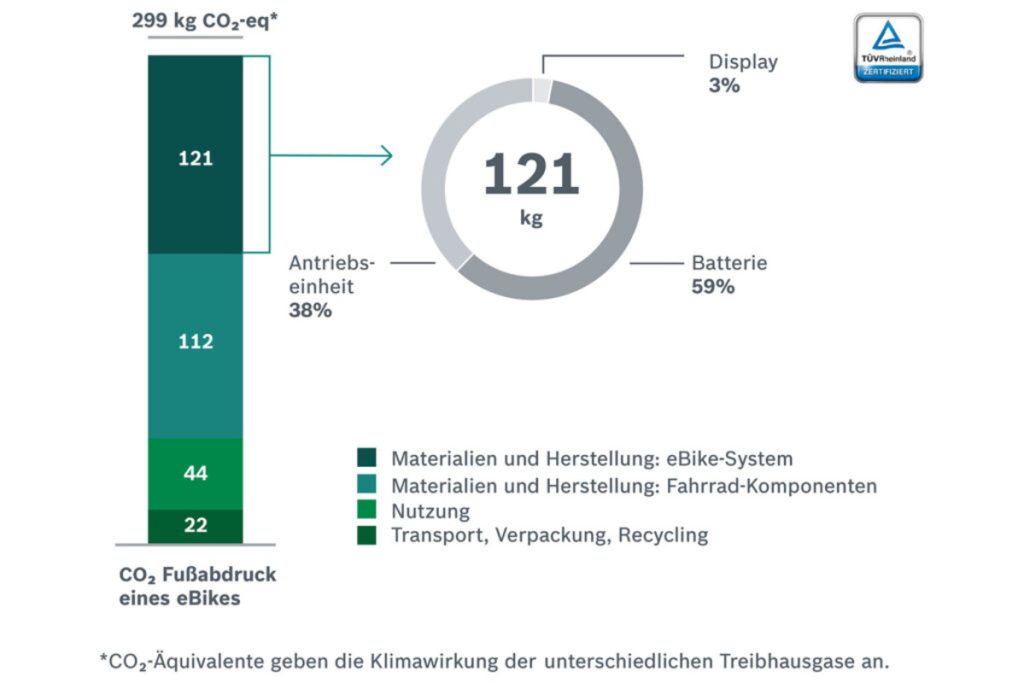
Together with TÜV Rheinland, Bosch has analyzed the CO2 footprint of e-bikes. According to this analysis, a pedelec produces an average of 299 kilograms of CO2 equivalents over its life cycle. Of this, 121 kilograms are attributable to the eBike system (drive unit, battery, display), with the battery accounting for the largest share (59%). Bicycle components account for 112 kilograms, use for 44 kilograms and transport, packaging and recycling for 22 kilograms. By comparison, a car with a combustion engine generates around 34,150 kilograms of CO2. If you use an e-bike instead of a car, the carbon footprint of the battery is offset after just 450 kilometers.
Source: Bosch
In addition, the environmental balance can be further improved if the e-bike battery is charged with electricity from renewable sources.
Advantages of retrofitting a bike with an e-bike motor
Retrofitting an existing bike with an e-bike motor offers several ecological advantages. Instead of buying a new e-bike, you can continue to use the existing bike and thus reduce the need for new materials. This avoids the CO2 emissions that would be generated during the production of a new e-bike (approx. 112 kg CO2-eq according to the graph above). Retrofitting extends the service life of the bike and at the same time improves the environmental balance, as no additional resources are required for a new bike. This is an ideal solution for environmentally conscious cyclists who want to upgrade their mobility sustainably.
E-bikes vs. normal bikes
However, switching from a classic bike to an e-bike does not bring any direct environmental benefits. The production of the battery causes additional CO2 emissions, which are only offset if the e-bike is actually used as a replacement for a car or other motorized means of transport. The advantage of the e-bike therefore lies in the avoidance of car journeys.
Environmental impact of battery production
A large part of the environmental impact of e-bikes is due to the production of lithium-ion batteries. These contain raw materials such as cobalt, nickel and lithium, the mining of which causes considerable ecological and social problems. The mining of lithium, for example, consumes large quantities of water, while cobalt mining can lead to the contamination of water sources.
To minimize these effects, a long battery life is crucial. The longer a battery is used, the lower the environmental impact per kilometer ridden. In addition, batteries can be reused in stationary energy storage systems after they have been used in an e-bike. At the end of their service life, they should be recycled in order to recover valuable raw materials and reduce the impact of primary extraction.
Conclusion
The carbon footprint of an e-bike is significantly lower than that of a car, making e-bikes an environmentally friendly alternative, especially for city dwellers and commuters. While the production of the battery causes initial emissions, these can be quickly offset by regular use and the replacement of car journeys. By retrofitting an existing bike, the environmental balance can be improved even further, as no additional emissions are generated for the production of a new e-bike. However, the key to sustainability lies in the responsible use of e-bikes and the conscious use of renewable energy when charging the battery.